Filed by: Fayilatu Issah/RadioMak
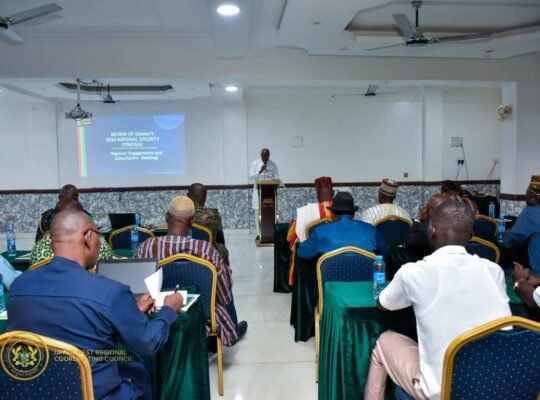
Ghana is reviewing its 2020 National Security Strategy to address emerging security challenges and respond to significant changes in the country’s domestic, regional and global security environment.
The review, according to a document from the National Security Council Secretariat, is required by law and reflects the need for countries to periodically assess their national security strategies to ensure they remain relevant and effective.
Ghana launched its first National Security Strategy in 2020. However, developments since its adoption have created the need for a revised framework capable of addressing evolving threats and strengthening the country’s security architecture.
One major concern highlighted in the review is the changing security situation in West Africa, particularly the deterioration of security in the Sahel region, characterised by the expansion of violent extremist groups, political instability and the withdrawal of some countries from the Economic Community of West African States (ECOWAS) in early 2025.
These developments have heightened concerns about the possible spread of violent extremism into coastal West African countries, including Ghana.
The document also identifies several domestic security challenges, including illegal small-scale mining, popularly known as galamsey, which continues to threaten the environment, weaken state authority in affected communities and fuel conflicts and organised criminal activities.
Intercommunal disputes, particularly those arising from chieftaincy disagreements and farmer-herder tensions, are also identified as threats to public safety. The growing incidence of cybercrime has further increased risks to citizens and critical national systems.
On technology, the review highlights the security implications of social media, artificial intelligence and digital financial systems. It notes that disinformation, influence campaigns, cyber-enabled financial crimes, electoral information manipulation and vulnerabilities in critical digital infrastructure require increased strategic attention.
Maritime and border security also feature prominently in the proposed review. Ghana’s extensive coastline and position as a regional trade and transport hub expose the country to threats such as narcotics trafficking, illegal fishing, piracy and armed robbery at sea in the Gulf of Guinea.
The country’s porous northern land borders also remain vulnerable to the movement of illicit goods, weapons and persons.
Additionally, climate change has been identified as a security threat multiplier, particularly through its impact on water scarcity, food insecurity and population displacement.
The review further seeks to align the National Security Strategy with the new legislative framework introduced by Act 1168, which establishes the Office of the National Security Co-ordinator.
Under the Act, the National Security Co-ordinator is responsible for coordinating the day-to-day activities of the National Security Council, Regional and District Security Councils, as well as security and intelligence agencies.
The ongoing constitutional review process is another consideration, with the revised strategy expected to promote consistency between national security policy and any constitutional or legislative changes that may emerge.
The document also emphasises the importance of consolidating Ghana’s democratic gains, particularly its record of peaceful democratic transitions and the smooth transfer of power following the December 2024 general elections.
It stresses that the revised strategy must be grounded in the rule of law, respect for human rights and civilian oversight of the security sector.
The review is expected to provide Ghana with an updated national security framework that responds effectively to emerging threats while strengthening democratic governance, national stability and the protection of citizens.